From construction to handover: what a moisture record should contain

Every project that monitors moisture produces a record. Whether that record is worth anything a year later depends on what went into it, when, and whether it reached the person who needs it. Most of the value of continuous monitoring during construction is in the questions it can answer afterwards: was this element dry when it was closed, what happened after the storm in week nine, who was told and what did they do. Those answers exist only if the record was kept as the building went up and handed over with it.
This article is the what. Two companion pieces cover the rest: flat-roof handover with continuous monitoring explains why the record matters in the defects period, and who owns moisture monitoring maps the responsibilities stage by stage. Here: where the record grows, what it should contain at handover, a report structure you can copy, and how to hand it over together with the live system.
Why a record, and not a set of readings
A moisture reading on a QA form records a visit. It says that on a given day, at a given point, someone measured a value. It does not say what happened the day after, or in the six weeks before the next visit. A record made from continuous readings shows what happened between the visits at the monitored points: the wetting after rain, the drying that followed, the point that never dried because it sat under a lap or against end grain.
The guidance the industry already uses points the same way. BUILD’s guidance on handling moisture in bio-based construction recommends documentation at the critical points of a project and a control plan whose intensity follows the moisture risk of the building, inside a chain of responsibility that runs from supplier to owner, with a moisture specialist signing off at the phase gates. In BUILD’s interview study of Danish timber buildings, the projects that later needed remediation were the ones without a written plan. And when RISE followed CLT buildings erected without weather protection, the moisture rounds the projects had documented could not establish how long water had stood on the surfaces between them. A record built from continuous readings at the monitored points closes the evidence gap those sources describe - what happened between the visits. It does not replace the written plan, the assigned responsibilities or the sign-off at each phase gate; those remain the project’s controls, and the record is what they refer to.
Where the record grows
The record is not written at handover. It accumulates at the critical points of construction, each of which adds something the later reader will want.
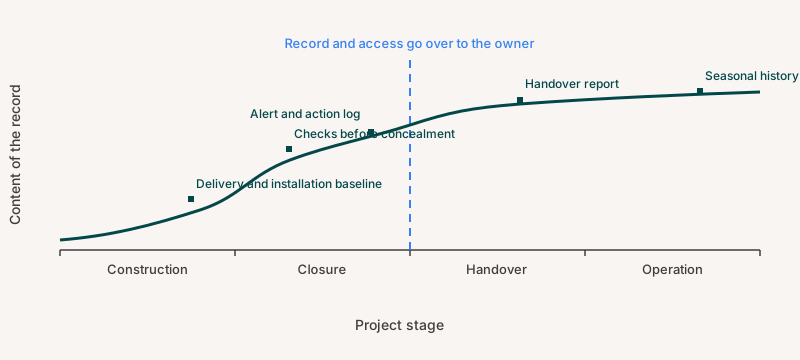
The record grows at the critical points of the build and goes over with the building. Schematic.
Delivery and installation. The condition the elements arrived in, with photos and any spot checks made against the supplier’s delivery criteria; the placement plan; the date each sensor was installed and registered against its position on the drawing; the first readings, which become the baseline for everything after.
Exposure. The trend at each monitored point through the period when the structure is open to weather: what rose after rain, how fast it fell, which points did not fall. This is where the record earns its keep, because it is the period nobody can reconstruct afterwards.
Before concealment. The confirmation, point by point, that the agreed criterion for closing, insulating or finishing was met before the element was covered. The criterion itself comes from the project’s moisture plan, the manufacturer and the consultant; the record shows that it was checked, when, and by whom.
Alerts and actions. Every alert with what was found, what was done and when the readings confirmed the fix. An alert without an action is an open question in the record; an action without the readings that followed is an unverified repair.
Closure and completion. The status of every monitored point at the moment the assembly was closed and at completion, including anything still drying and anything unresolved.
The checklist: what the record contains at handover
The handover record combines what the contractor’s QA system already holds with what the monitoring platform holds. When the platform has been used through the build, most of the list below already exists and needs only to be assembled.
- Sensor and gateway register - every device, its identifier, its position on the roof plan or structural drawing, the element it sits in and the date it was installed.
- Marked-up locations - the drawings with sensor positions, so an alert years later can be located without a search.
- Tags and thresholds - the reference values and alert rules applied to each sensor, and the construction-phase setting that was changed to after construction when the element was complete - the setting changes the reference values applied to the sensor.
- Measurement context - for each sensor: the material, the assembly and the depth or layer it measures in; the exact location and sensor identifier; what it measures, in which unit and at which interval; the installation and verification dates; where each threshold came from and who approved it. Without this a trend history cannot be read by someone who was not there.
- Trend history - the full reading history for every sensor from installation, not a summary; the summary goes in the report.
- Changes and gaps - sensor replacements and relocations, gateway outages and any period without data, with dates, so a gap in the history is never mistaken for a dry period.
- Alert and action log - each alert, the investigation, the corrective action and the readings that confirmed it.
- Status at closure - the condition of every monitored point when its assembly was closed, and at completion.
- Unresolved risks - anything still drying, any point that never met its criterion, any known defect under observation.
- Final report - the document below, signed off by the party responsible for moisture control on the project.
- Access and subscription - who has access to the live project after handover, at which level, who is responsible for the continuing subscription, and what historical data remain available to them.
A sample report structure
A report that follows the structure below can be produced from the record without new writing. Adapt the headings to the project’s own QA system; keep the order, because it follows the questions an owner, a consultant or an insurer asks.
- Project and scope - the building, the monitored elements and roof areas, the period covered, the parties.
- Monitoring set-up - the sensor and gateway register, the measurement context per sensor, the placement plan and the reasoning behind the positions (critical areas first).
- Criteria - the acceptance criteria used for closing, insulating and finishing, and their source (contract, manufacturer, consultant).
- Exposure and drying history - the trend per element or zone through construction, with the weather events that explain it.
- Confirmation before concealment - the point-by-point confirmation that criteria were met, with dates and the responsible person.
- Alerts and corrective actions - the log, with outcomes.
- Status at completion - what is dry, what is still drying, what is unresolved.
- Handover of the live system - the users added, their access level, the alert recipients after handover, the subscription holder.
- Recommendations for operation - what to watch in the first years, which points deserve attention at the seasonal peak, and what would trigger an investigation.
- Sign-off - the professionals who accept the record. The data document the conditions; the sign-off is a professional judgement, not a property of the data.
The first years after handover
A record that stops at handover misses the period when a building shows what it is made of. Built-in construction moisture works its way out over months, not days. In a flat roof the seasons drive moisture down in summer and push condensation risk up in autumn and winter, and the late-winter peak is where a roof with a hidden problem separates from a roof without one. BYG-ERFA, the Danish building-practice foundation, says the same in its guidance on measuring moisture in Danish roof structures: moisture is normally highest in February and March, and a measuring programme that cannot run for a year or two should at least cover those months. That is guidance for one climate and one building tradition; contractual, regulatory and climatic requirements vary by market, so the monitoring period and the criteria for a given building belong in its own moisture plan. The seasonal patterns are described in why condensation in flat roofs spikes in autumn and moisture in warm roofs during summer.
For the owner, this means the record keeps growing after handover: the same sensors, the same positions, now with a named reader on the owner’s side. For the contractor, it means that a question in the defects period can be answered from a dated reading at a named position rather than from a survey of the whole roof. Flat-roof handover with continuous monitoring describes what that does for both sides.
Handing over access
The record and the live system go over together, and both need a person on the receiving end. What follows is the practical sequence, not a formal transfer workflow. Access in the Tector platform is granted at organisation, project-group or subgroup level. An Owner has full access and manages users and devices; a Member can contribute and set up sensors; a Guest is read-only. Owners and Members with access to a project receive alert emails by default, and an alert can only be assigned to a user who has access to that project.
The practical handover is short, and it works best before completion rather than after:
- Invite the owner’s or facility manager’s users to the project or organisation while the contractor is still engaged.
- Assign the access level each person needs, and give an appropriate person on the owner’s side Owner access.
- Verify their login and their alert settings, so the first alert after handover reaches someone who will act on it.
- Keep the existing project as the continuity record, so the owner’s users join the construction-period project rather than starting from an empty one, and confirm which historical data will remain available to them.
- Confirm who is responsible for the continuing subscription from the handover date, and how any project records that must be retained independently of the platform will be archived.
A consultant or contractor keeps access only where their role after completion requires it, for example through the defects period. The common failure is not technical: it is an owner who inherits a system nobody told them about, with alerts routed to a site manager who has moved on. Naming the receiving person before handover is the fix, and it belongs in the record.
What the record is not
Continuous readings document the conditions at selected points. They do not certify that a building complies with a standard, a contract or a regulation, and they do not replace the inspections, weather protection and site discipline that keep a structure dry in the first place. The acceptance criteria, the response duties and the sign-off belong to the contract and to the professionals on the project; the record gives them the evidence to decide on. Written that way, the record is something every party can stand behind, which is the point of keeping one.
Two projects that kept the record
The Faroe Islands’ first CLT building. The team set moisture thresholds for each building component at the start, integrated the daily sensor updates into their quality-assurance system, and used the data to decide when it was safe to insulate or paint. Detailed reports generated from the platform went to project management to document progress and moisture control, and sensors stayed in the building to record its condition after completion. Read the Faroe Islands case.
Copenhagen school roofs. Four roof surfaces at different levels under gardens, solar panels and play equipment. During construction, sensors placed at the key locations picked up rain that had entered an assembly left uncovered and told the contractor where the water had come in and whether the roof needed further drying before it was closed: a defect found, fixed and documented before handover, with the readings to show it. Read the school roofs case.
Starting the record on your project
The structure above is the same on every project; the monitored points, the criteria and the responsible names are not. That is what the project assessment settles, before anyone buys anything: which elements and areas to monitor, where the critical points are, who receives alerts during construction and after, and what the handover should contain for this building.
Request a project assessment. For the systems themselves, see moisture monitoring for flat roofs, wireless moisture sensors for timber and how the system works.